
Where to See Chimpanzees in Uganda: Chimpanzee Destinations
Where to See Chimpanzees in Uganda: Chimpanzee Destinations, Uganda offers several ways to see wild chimpanzees, but the experience is quite different from watching elephants or buffalo from a safari vehicle.
Here, you enter the forest on foot. The trail may be quiet for long stretches, with birds calling above the canopy and monkeys moving through the trees, before a distant chimpanzee call suddenly changes the pace of the walk. Trackers listen carefully, follow signs of movement and work out where the chimpanzee community has moved.
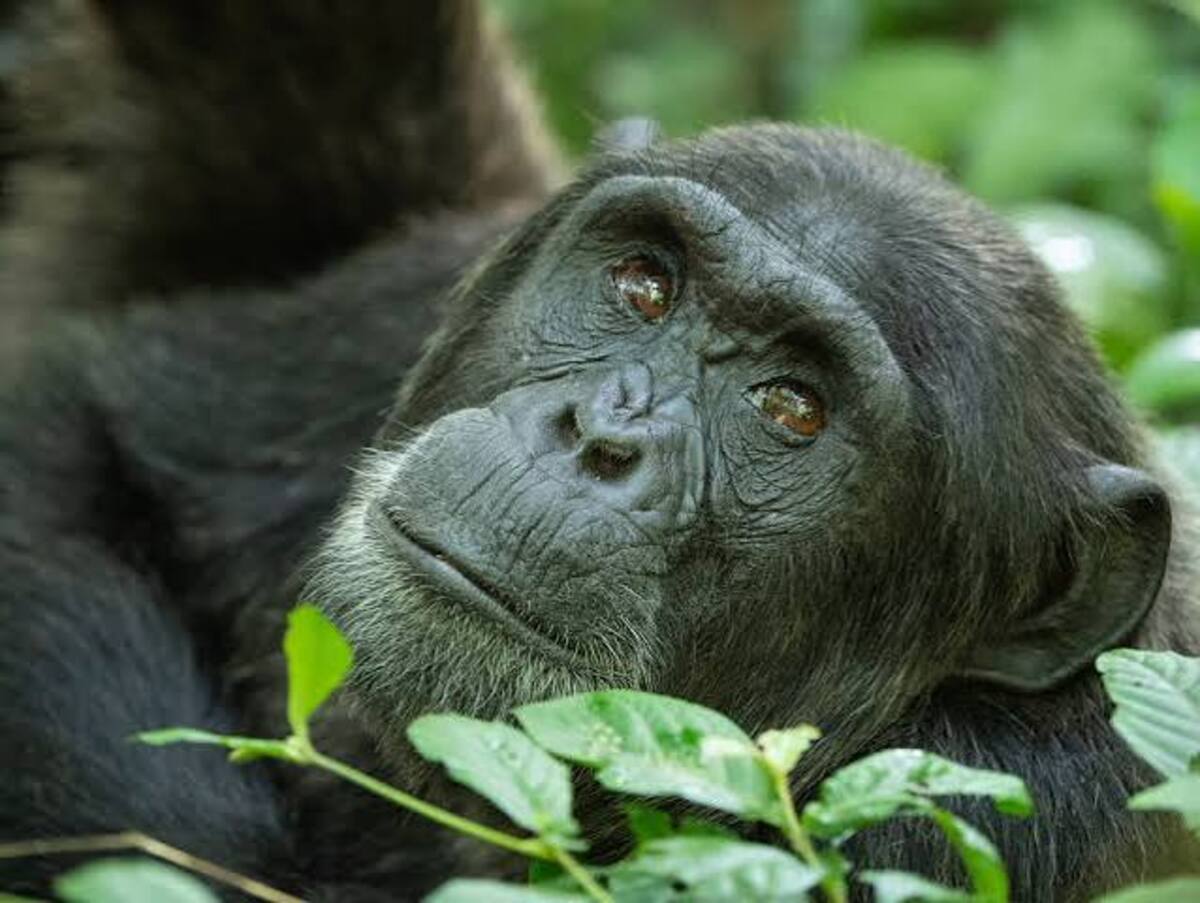
For many visitors, Kibale National Park is the best place to begin. It has Uganda’s strongest established chimpanzee tracking experience and supports more than 1,500 chimpanzees. But it is not the only option. Kyambura Gorge, Budongo Forest, Kalinzu Forest, Bugoma Forest, Semuliki National Park and Toro-Semliki offer different experiences that can make sense depending on your safari route.
The important thing is to understand what chimpanzee tracking actually involves before choosing a destination. These are wild animals in natural forest. Sightings are not guaranteed, and the walk can involve uneven ground, steep sections, mud and several hours on foot.
The Best Places to See Chimpanzees in Uganda
For most first-time visitors, the choice comes down to the route they want to follow and how important chimpanzees are to the overall safari.
| Destination | Best suited to |
| Kibale National Park | Travellers making chimpanzees a major priority |
| Kyambura Gorge | Combining chimpanzees with a Queen Elizabeth safari |
| Budongo Forest | Combining chimpanzees with Murchison Falls |
| Kalinzu Forest | A chimpanzee experience near Queen Elizabeth National Park |
| Bugoma Forest | Travellers interested in less-visited forest landscapes |
| Semuliki National Park | Primates, forest, birds and the Sempaya Hot Springs |
| Toro-Semliki Wildlife Reserve | Longer, more specialised primate walks |
There is no single destination that is best for every traveller. If chimpanzees are the main reason for your trip, Kibale is generally the strongest choice. If chimpanzees are one part of a larger safari, another forest may fit your itinerary better.
Kibale National Park: Uganda’s Main Chimpanzee Destination
If your main goal is to see wild chimpanzees, Kibale National Park is usually the most straightforward choice.
The forest supports more than 1,500 chimpanzees and is also one of Uganda’s richest areas for primates. Red colobus, black-and-white colobus, red-tailed monkeys, grey-cheeked mangabeys and L’Hoest’s monkeys are among the species found here.
Chimpanzee tracking normally starts around the Kanyanchu area. Before entering the forest, visitors receive a briefing and then walk with guides and trackers who follow the movements of the chimpanzee community.
There is no fixed route and no set amount of time before the animals are located. Sometimes the chimpanzees are relatively close. At other times, the tracking team may need to walk considerably farther.
That uncertainty is part of the experience.
You may spend part of the morning walking quietly beneath tall trees, hearing chimpanzees calling somewhere above you without being able to see them. Then the trackers identify the direction of the calls and the walk changes into a more focused search.
Once the chimpanzees are located, normal tracking allows a maximum of one hour with the animals.
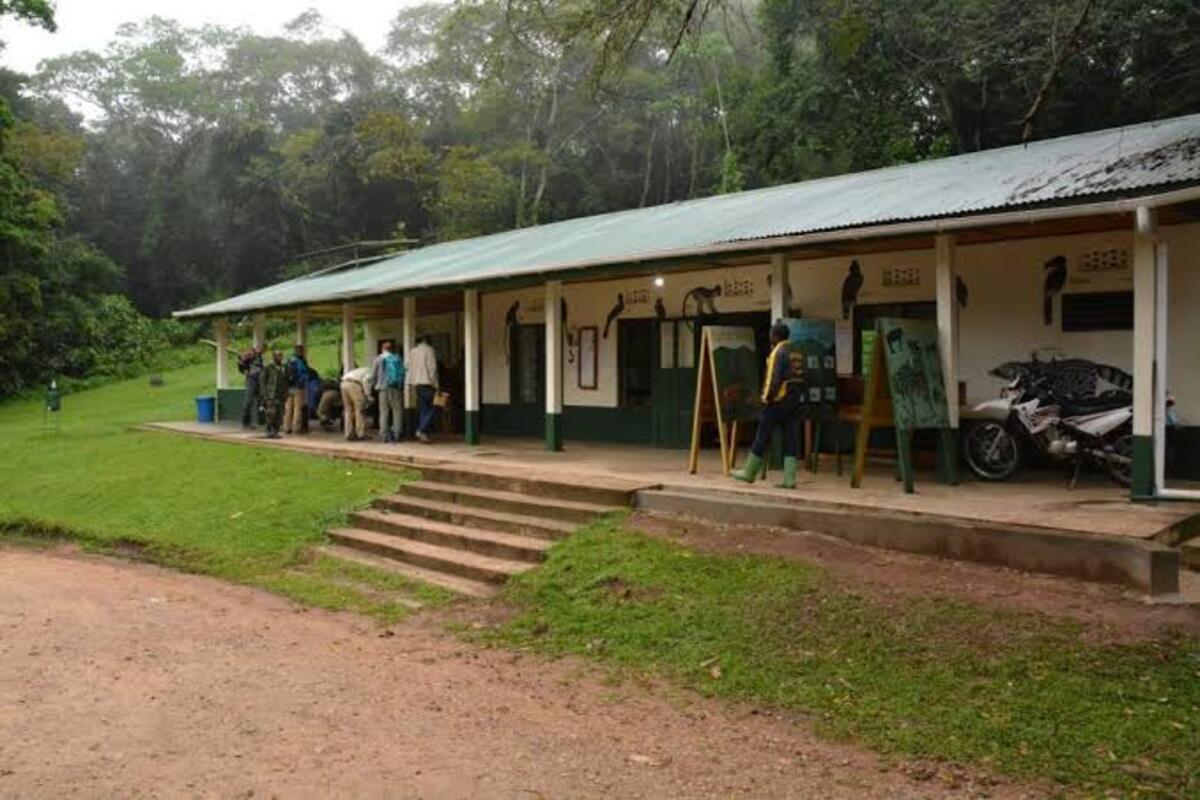
Kanyanchu Visitors centre
Chimpanzee Habituation Experience in Kibale
For travellers who want considerably more time with chimpanzees, Kibale also offers the Chimpanzee Habituation Experience.
This differs from ordinary tracking because visitors follow a less-habituated chimpanzee community for a much longer period. The experience allows up to four hours of viewing once the chimpanzees are located.
The day also starts earlier than normal chimpanzee tracking.
Habituation suits travellers who have a particular interest in primate behaviour, conservation or photography. It requires more patience, however, and often involves more walking because semi-habituated chimpanzees can move unpredictably through dense forest.
If you are choosing between the two, normal tracking is usually easier to fit into a conventional Uganda safari. Habituation makes more sense when observing chimpanzees is one of the central purposes of the trip.
Kyambura Gorge: Chimpanzees in Queen Elizabeth National Park
Kyambura Gorge offers a very different setting from Kibale.
The forest occupies a steep-sided gorge within Queen Elizabeth National Park, with open savannah landscapes surrounding the forest. This makes Kyambura particularly useful for travellers who want to combine chimpanzee tracking with a traditional wildlife safari.
A single itinerary can include a morning chimpanzee trek followed by game drives in search of elephants, buffaloes, antelope, lions and leopards. A boat trip along the Kazinga Channel can also be added.
The forest walk itself is part of the attraction. You descend into the gorge, follow forest trails and listen for chimpanzee activity around you.
Sightings are not guaranteed. The chimpanzees are free-ranging and may remain high in the trees or move deeper into the forest..
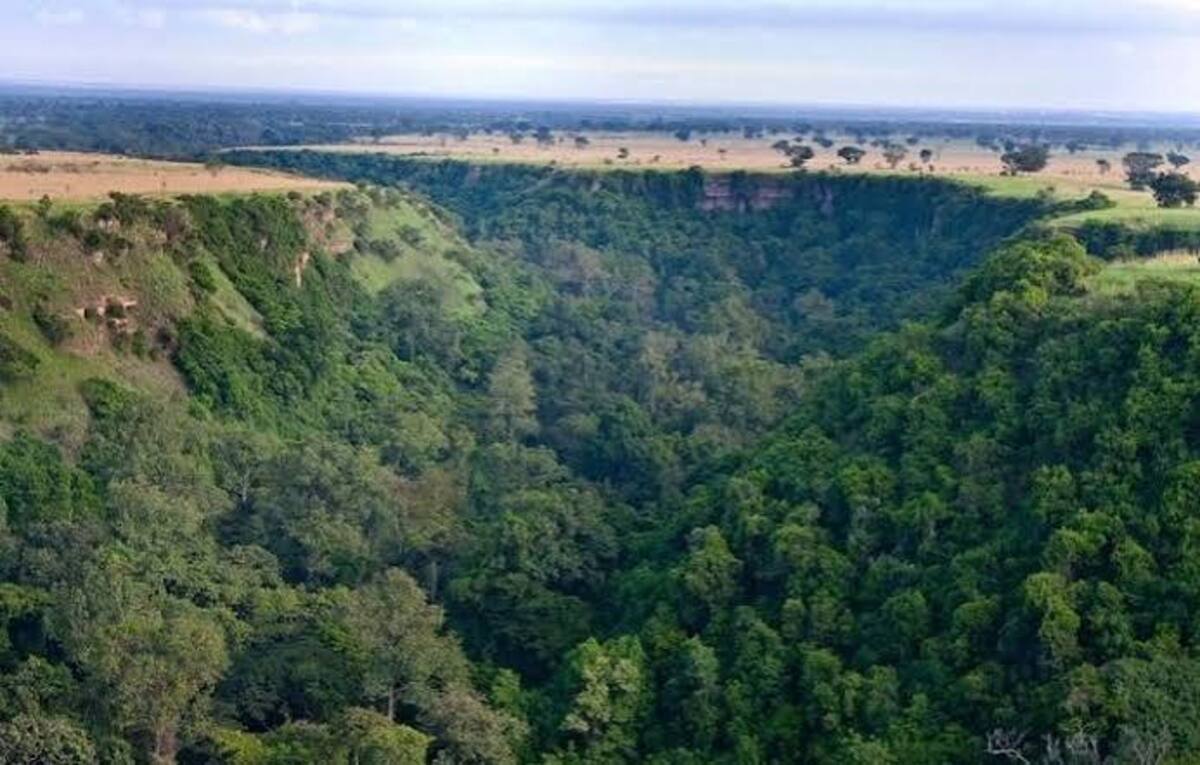
Forested walls of Kyambura Gorge rising from the surrounding Queen Elizabeth savannah.
Budongo Forest: Chimpanzees Near Murchison Falls
Budongo Forest is another important chimpanzee habitat and can be a sensible choice for travellers who are already planning a safari around Murchison Falls.
The forest forms part of the wider Murchison Falls Conservation Area and has a long history of chimpanzee research and habituation.
Its atmosphere is very different from the open savannah landscapes elsewhere in the conservation area. Instead of watching wildlife from a vehicle, you spend time beneath tall forest trees, following trails and listening for movement in the canopy.
Budongo works particularly well as part of a broader northern Uganda itinerary. Visitors can combine the forest experience with game drives, a boat safari and a visit to Murchison Falls.
For travellers whose main priority is chimpanzee tracking, Kibale remains the more established choice. Budongo becomes more attractive when the wider Murchison Falls itinerary is already part of the plan.
Kalinzu Forest: Chimpanzees Near Queen Elizabeth National Park
Kalinzu Forest provides another option for travellers exploring western Uganda.
Its location close to Queen Elizabeth National Park makes it possible to combine a forest primate experience with game drives and other activities in the surrounding region.
The forest is known for its chimpanzee population and guided walks through mature tropical forest. As with every chimpanzee destination, sightings depend on where the animals are on the day of your visit.
Chimpanzees can move through dense vegetation or high into the canopy, so patience is important. The experience is less about walking directly to a predictable viewing point and more about following signs and sounds through the forest.
Kalinzu can work particularly well in an itinerary that continues towards Bwindi for mountain gorilla trekking.
For someone visiting Uganda for the first time with chimpanzees as the main priority, Kibale is still the stronger overall choice. Kalinzu becomes particularly practical when your route already takes you through the Queen Elizabeth and Bwindi region.
Bugoma Forest: A Less-Visited Chimpanzee Destination
Bugoma Forest offers a different kind of forest experience.
Located in western Uganda between Hoima and Kikuube, the forest forms part of a wider landscape of important forest habitats. Compared with Uganda’s best-known chimpanzee destinations, tourism here has a more exploratory character.
That can appeal to travellers who want to include a less-visited forest in a longer western Uganda itinerary.
The experience is best approached as a genuine forest walk rather than a highly structured wildlife encounter. Chimpanzees are free-ranging, and seeing them is never something to take for granted.
Bugoma is therefore not usually the first choice for a traveller whose only objective is to maximise the likelihood of seeing chimpanzees. It can, however, add another dimension to a longer primate, conservation or western Uganda journey.
Semuliki and Toro-Semliki: Chimpanzees Beyond the Usual Route
Further west, Semuliki National Park and the nearby Toro-Semliki Wildlife Reserve provide less conventional chimpanzee experiences.
Semuliki protects lowland tropical forest with strong Central African influences. Chimpanzee tracking take places there throughout the year, but chances of seeing the chimpanzees are less.
The park is also known for the Sempaya Hot Springs and its rich forest birdlife. For that reason, it is particularly interesting for travellers who want a broader nature experience rather than a trip focused only on chimpanzees.
Toro-Semliki offers a primate walk lasting roughly three to four hours. Chimpanzees are among the species visitors may encounter, together with other monkeys and wildlife.
These destinations are more specialised choices. They can make sense for repeat visitors, birdwatchers or travellers taking a longer route through western Uganda.
When Is the Best Time to See Chimpanzees in Uganda?
Chimpanzee tracking is possible throughout the year.
There is no particular month when chimpanzees leave the forest, so it is usually better to plan the timing of your wider Uganda safari first rather than trying to find one supposedly perfect month for chimpanzee tracking.
Weather does affect the experience.
Rain can make forest trails muddy and slippery, while drier conditions can make walking easier. At the same time, chimpanzee movements are influenced by food availability. Chimpanzees can move deeper into the forest during dry periods in search of food, while rainy-season conditions can sometimes be useful for locating them.
In practical terms, you should prepare for changing conditions rather than expect the forest to behave according to a fixed seasonal pattern.
What Is Chimpanzee Tracking Actually Like?
Chimpanzee tracking is not a technical mountain hike, but it does require reasonable mobility.
You may walk for several hours over:
- Uneven forest trails
- Slippery or muddy ground
- Slopes and inclines
- Narrow paths
- Areas where vegetation makes walking slower
You do not need to be an experienced hiker. However, comfortable walking shoes and a reasonable level of fitness make the experience much easier.
If you have limited mobility, discuss this before booking. Different chimpanzee destinations have different terrain and logistical arrangements, so choosing the right location matters.
The total time spent in the forest can also vary significantly. The chimpanzees may be nearby, or they may have moved farther away before the trackers locate them.
What Should You Wear and Pack?
A practical chimpanzee trekking kit includes:
- Lightweight long trousers
- A long-sleeved shirt
- Sturdy hiking shoes
- Insect repellent
- Sunscreen
- Drinking water
- A rain jacket
- A small daypack
- Camera and spare batteries or power bank
Long trousers and sleeves are useful for moving through forest vegetation and reducing exposure to insects.
A rain jacket is worth carrying even when the morning begins dry. Forest weather can change quickly.
Photography: What Should You Expect?
Chimpanzee photography is more challenging than many first-time visitors expect.
Chimpanzees are active animals. They may move quickly through branches, disappear behind vegetation or remain high in the canopy. The forest floor is also often much darker than the surrounding open landscape.
A camera with a useful zoom lens is therefore more practical than relying entirely on a phone.
A fast lens and a camera that performs reasonably well at higher ISO settings can be particularly useful in low forest light.
The most important piece of equipment, however, is patience.
Do not expect the chimpanzees to sit still simply because you have found them. Sometimes the best photograph comes after waiting quietly for an animal to move into an opening in the vegetation.
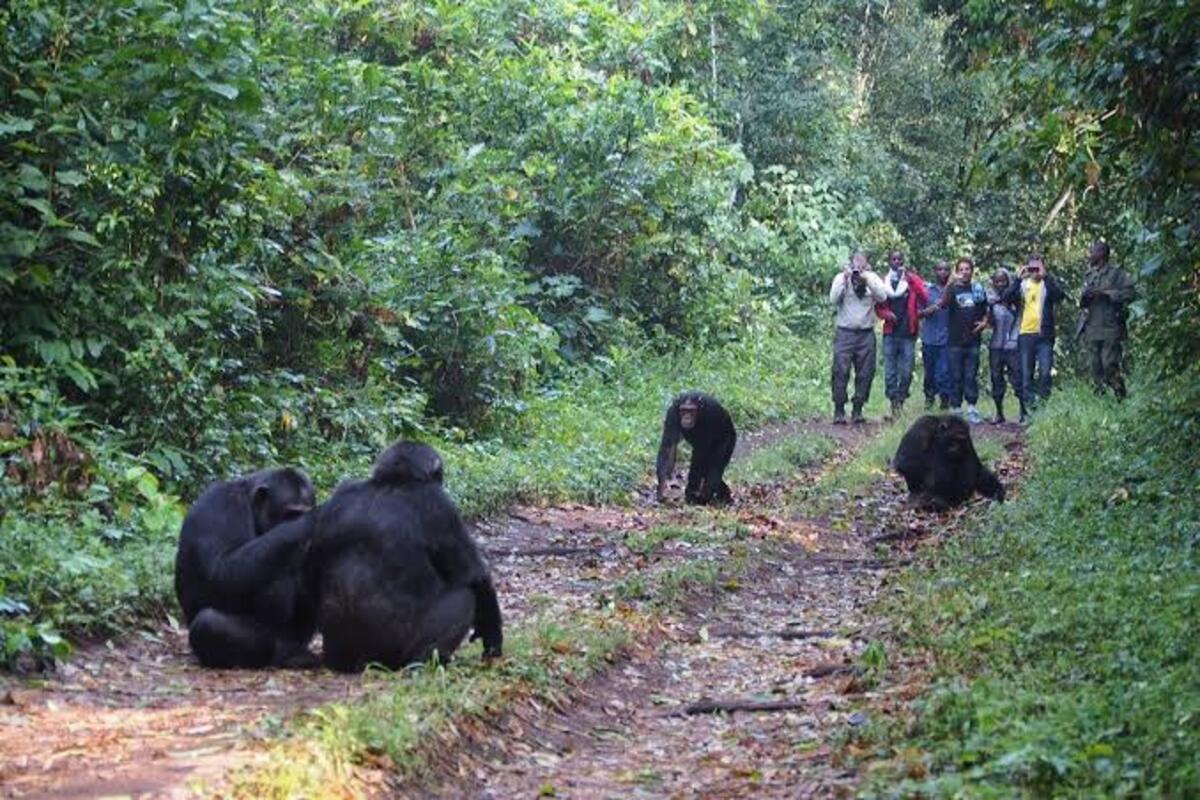
A Tourist photographing a chimpanzees on the road
How Much Does Chimpanzee Tracking Cost in Uganda?
Chimpanzee permit and activity fees depend on the destination and tariff period.
- Kibale chimpanzee tracking: US$300 FNR
- Kibale Chimpanzee Habituation Experience: US$400 FNR
- Kyambura chimpanzee tracking: US$200 FNR
- Kalinzu forest reserve tracking US$130 FNR
- Budongo forest reserve tracking US$130 FNR
These figures are activity fees, not the total price of a Uganda safari. A complete safari budget also needs to account for accommodation, transportation, meals, guiding, park fees and other activities.
Because UWA tariffs can change, travellers planning a future trip should confirm the applicable rate before finalising their budget.
How Long Does a Chimpanzee Trek Take?
There is no single answer.
The time required to locate the chimpanzees depends on their movements, terrain and weather. You may find the community relatively quickly, or you may spend considerably longer walking through the forest.
Once the chimpanzees are located, the standard viewing period at Kibale is limited to one hour.
The Chimpanzee Habituation Experience allows up to four hours of viewing and is therefore much better suited to visitors who want extended observation.
Remember that the viewing time is different from the total time spent on the trek.
What Are the Chances of Seeing Chimpanzees?
Chimpanzee tracking takes place in established habitats with experienced trackers, but no responsible operator should promise a guaranteed sighting.
Chimpanzees are wild animals. They move according to food, social behaviour, weather and other factors. They can also spend time high in the canopy or in dense vegetation where visibility is limited.
This is why the experience is better understood as wildlife tracking rather than a guaranteed wildlife encounter.
The sounds and signs encountered along the way are part of the experience, even before you see the animals themselves.
Tracking or Habituation: Which Should You Choose?
The choice depends largely on how much time and interest you have.
Choose normal chimpanzee tracking if:
- You want to include chimpanzees within a broader Uganda safari.
- You prefer a shorter forest experience.
- You want time for other activities on the same day.
- Chimpanzees are important but not the sole focus of your trip.
Choose chimpanzee habituation if:
- You have a strong interest in primate behaviour.
- Photography is an important part of your safari.
- You want substantially more observation time.
- You are comfortable with a longer and potentially more demanding forest experience.
For most first-time visitors combining chimpanzees with gorillas and classic wildlife, standard tracking is often the simpler option.
Responsible Chimpanzee Tourism
Chimpanzees are closely related to humans, which makes responsible behaviour particularly important.
Follow the ranger’s instructions throughout the experience and maintain the required distance from the animals. Never attempt to touch, feed or attract a chimpanzee.
Do not leave rubbish in the forest, and avoid behaviour that unnecessarily disturbs the animals.
The wider conservation picture matters too. Habitat loss, snares and disease are among the threats facing Uganda’s chimpanzees.
Responsible tourism cannot solve every conservation challenge, but following established rules helps protect the animals and the forest environments on which they depend.
Accommodation and Getting There
Your choice of chimpanzee destination should also consider where you want to stay and how the experience fits into your overall route.
Around Kibale, travellers can choose from comfortable forest lodges, camps and more upscale accommodation. The most suitable property depends on your budget and the standard of accommodation you prefer.
Road travel is the backbone of most Uganda safaris, and distances can be greater than they appear on a map.
If you are travelling overland from Kampala, allow sufficient time for the journey rather than treating the drive as a simple transfer. Main highways can be relatively straightforward, while roads away from the main routes vary considerably in condition.
This is one reason itinerary design matters. A good chimpanzee destination is not necessarily the best destination if reaching it creates an unnecessarily difficult route for the rest of your safari.
Can You Combine Chimpanzees, Gorillas and a Classic Safari?
Yes, and this is one of the strengths of planning a safari in western Uganda.
A route can combine Kibale for chimpanzee tracking, Queen Elizabeth National Park for savannah wildlife and Bwindi for mountain gorilla trekking.
The three experiences are quite different.
Chimpanzee tracking takes you beneath the forest canopy. Queen Elizabeth offers game drives and the opportunity to explore the Kazinga Channel. Bwindi introduces a different kind of forest trek in search of mountain gorillas.
Rather than trying to fit every possible activity into a short trip, consider how much time you want to spend travelling versus actually experiencing each destination.
Common Mistakes First-Time Visitors Make
One of the most common mistakes is assuming chimpanzee tracking is similar to a game drive.
It is not.
You walk. You wait. You listen. You follow.
Another mistake is choosing a destination solely because the permit is cheaper without considering the rest of the itinerary. Kyambura, for example, can make excellent sense for a Queen Elizabeth safari, while Kibale is usually the stronger choice when chimpanzees are a primary objective.
It is also worth avoiding overly ambitious itineraries. Uganda’s roads and distances mean that a schedule that looks efficient on paper can become tiring when every day involves several hours of driving.
Finally, do not underestimate the importance of footwear and rain protection. Forest conditions can change quickly, and comfortable shoes can make a substantial difference to the experience.
Planning Your Chimpanzee Safari in Uganda
For a first visit, Kibale National Park is generally the clearest choice when chimpanzees are high on your priority list.
Its established tracking programme, large chimpanzee population and exceptional diversity of other primates make it particularly easy to combine with a broader western Uganda safari.
But the alternatives deserve consideration.
Kyambura works naturally with Queen Elizabeth National Park. Budongo fits well into a Murchison Falls itinerary. Kalinzu can work well around Queen Elizabeth and Bwindi. Bugoma offers a less-visited forest experience, while Semuliki and Toro-Semliki suit travellers looking for a more specialised route.
The best choice therefore depends not only on where the chimpanzees are, but also on what else you want to experience.
Frequently Asked Questions About Chimpanzee Trekking in Uganda
Where is the best place to see chimpanzees in Uganda?
Kibale National Park is generally the leading choice for travellers specifically interested in chimpanzee tracking. The park supports more than 1,500 chimpanzees and has an established tracking programme.
Can I see chimpanzees and gorillas on the same Uganda safari?
Yes. Kibale can be combined with Bwindi, allowing you to experience chimpanzee tracking and mountain gorilla trekking during the same Uganda safari.
Is chimpanzee tracking difficult?
It can be moderately demanding. Trails may be muddy, uneven or steep, and the chimpanzees can move over considerable distances. A reasonable level of fitness and comfortable walking shoes are recommended.
How long does chimpanzee tracking take?
The length of the trek varies depending on where the chimpanzees are and how they move. At Kibale, standard tracking allows up to one hour of viewing once the chimpanzees are located. The habituation experience allows up to four hours of viewing.
Are chimpanzee sightings guaranteed?
No. Chimpanzees are wild and free-ranging. They may move through dense vegetation or high into the canopy, so sightings remain subject to natural conditions.
What is the difference between chimpanzee tracking and habituation?
Standard tracking provides a shorter viewing experience and works well as part of a broader safari. Habituation allows much longer observation and is better suited to visitors with a strong interest in chimpanzees, behaviour or photography.
When is the best time to track chimpanzees in Uganda?
Chimpanzee tracking is possible throughout the year. Weather affects trail conditions, but there is no single month that guarantees better sightings. It is usually more useful to plan your overall Uganda safari first and fit chimpanzee tracking into the route.
What should I wear for chimpanzee trekking?
Wear comfortable long trousers, a long-sleeved shirt and sturdy hiking shoes. Carry insect repellent, sunscreen, drinking water and a rain jacket.
Can children go chimpanzee tracking?
Age requirements can vary between destinations and activities. Families should confirm the current rules with the relevant authority or safari operator before booking, particularly when planning chimpanzee tracking alongside gorilla trekking.
Is chimpanzee tracking suitable for people with limited mobility?
The experience can involve uneven, muddy and steep terrain, so it is important to discuss mobility requirements before booking. The choice of destination can make a significant difference.
Should I choose Kibale or Kyambura?
If chimpanzees are one of the main reasons for your Uganda safari, Kibale is generally the stronger choice. If you are already visiting Queen Elizabeth National Park and want to add a chimpanzee experience without making a separate journey to Kibale, Kyambura or Kalinzu forest can be a practical alternative.
A Forest Experience Worth Taking Slowly
Chimpanzee tracking is about more than the moment when an animal finally appears.
The forest begins to tell its story before you see anything clearly: calls travelling through the canopy, leaves shaking somewhere overhead, feeding signs on the ground and the quiet concentration of the tracking team as they work out where the chimpanzees have gone.
That uncertainty is part of what makes the experience different from conventional safari viewing.
For first-time visitors, Kibale offers the most straightforward introduction to Uganda’s chimpanzees. But Kyambura, Budongo, Kalinzu, Bugoma, Semuliki and Toro-Semliki each provide a different way of exploring the country’s forests and primate habitats.
The right choice depends on how much time you have, what else you want to see and whether chimpanzees are the central purpose of your safari or one part of a much larger journey.
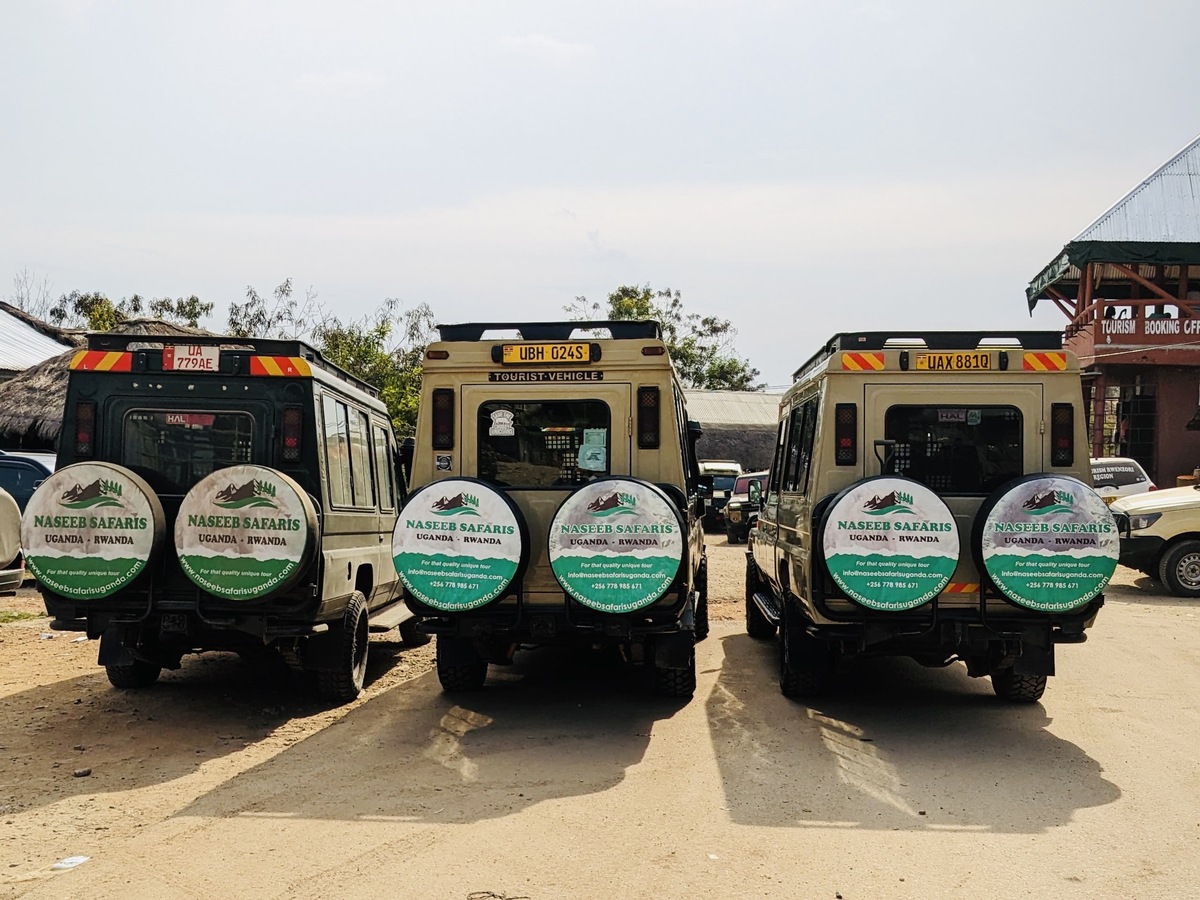
If you are unsure which destination fits your route, travel dates, accommodation preferences or wider safari plans, Naseeb Safaris can help you work through the options and build a Uganda itinerary around the experiences that matter most to you.